
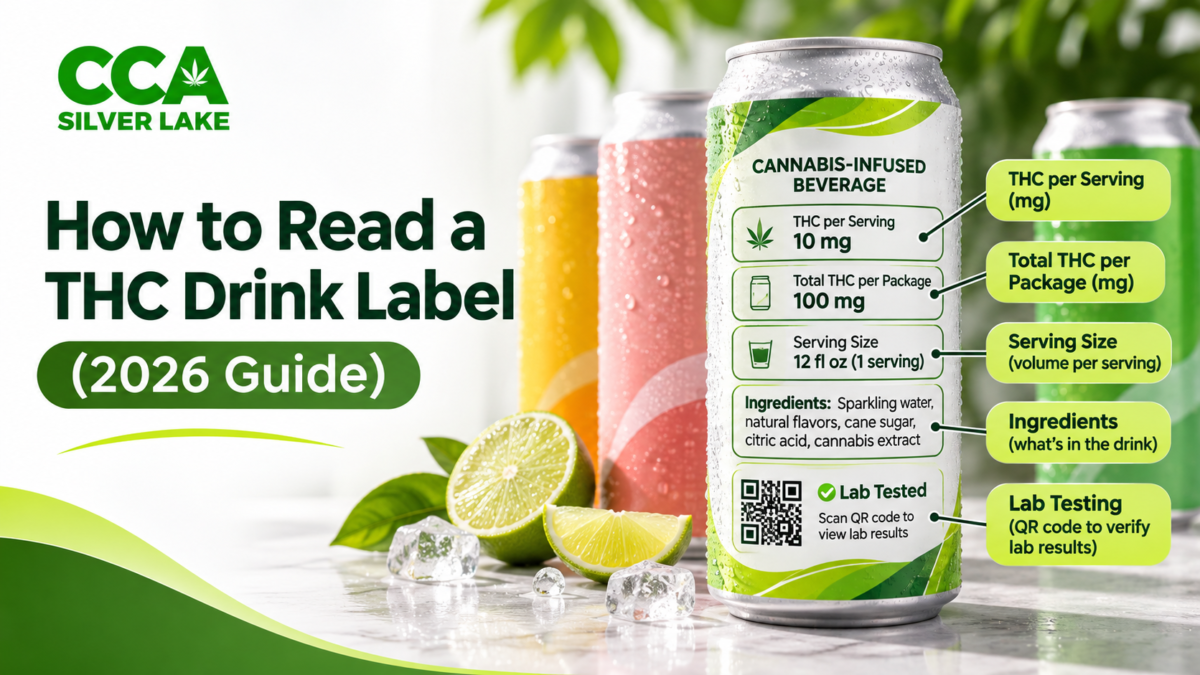
A cannabis beverage can look similar to a regular soda, sparkling water, or flavored tea, but its label contains information that deserves closer attention. THC content, serving size, total package potency, and additional cannabinoids can all influence how you understand a product before purchasing it.
The range of available strengths makes label reading particularly important. According to THC Beverage Consumer Survey of 1,637 adults who had tried THC beverages, 29.4% identified 10mg as their most commonly purchased dose, while 23.7% selected 50mg. This variation highlights why understanding THC amounts per serving and per container matters when comparing cannabis beverages.
Cannabis beverages come in several formats, including sparkling drinks, flavored teas, sodas, and concentrated shots. Products such as 21st Amendment Mango 100mg, Blue Raz Shot 100mg, and Gold Lucky Lemon Tea THC:CBG 100:20mg illustrate the variety of options available.
This guide explains how to read a THC drink label in 2026, what each section means, and which details deserve your attention before choosing a cannabis beverage.
1. Check the THC Amount Per Serving
The first detail to look for on a THC drink label is the amount of THC in each serving. This information is generally displayed in milligrams (mg).
THC, or tetrahydrocannabinol, is the primary intoxicating cannabinoid in cannabis. The milligram amount indicates how much THC a serving contains, making it easier to compare the potency of different beverages.
However, the amount listed on the front of a can or bottle may represent the entire product rather than a single serving.
For example, a beverage labeled as containing 100mg of THC may contain multiple servings. If the container has five equal servings, the amount per serving would be 20mg.
This distinction matters because consuming the entire container could mean consuming significantly more THC than intended.
What to Look For
Check these details on the packaging:
- THC per serving: The amount of THC in one recommended serving.
- Serving size: The quantity of beverage that counts as one serving.
- Number of servings: How many servings the entire container contains.
- Total THC: The combined amount of THC across the full can, bottle, or package.
Consider products such as 21st Amendment Mango 100mg and 21st Amendment Watermelon 100mg. Their product names identify them as 100mg options, but you should check the packaging to establish the exact amount per serving and total container potency.
The same approach applies to Blue Raz Shot 100mg. A concentrated shot may have a different serving size from a standard beverage can, so reviewing the label is especially important.
Never assume that the entire container represents one serving. Use the manufacturer’s serving information to understand the product’s actual THC content.
2. Understand Total THC Per Container
THC per serving and total THC per container are two different measurements. Understanding both helps prevent confusion when comparing cannabis beverages.
Total THC represents the combined amount of THC in the entire product. The serving amount tells you how much THC is present in the recommended portion.
If a beverage contains multiple servings, you can calculate its total THC using this formula:
THC per serving × Number of servings = Total THC per container
For example:
| THC per serving | Number of servings | Total THC |
| 5mg | 2 | 10mg |
| 5mg | 4 | 20mg |
| 10mg | 2 | 20mg |
| 10mg | 5 | 50mg |
These examples demonstrate why checking the serving count matters. Two beverages may have the same THC amount per serving but different total package potency.
Why Package Size Matters
A larger bottle does not automatically contain more THC per serving. Similarly, a smaller shot may contain a substantial amount of THC in a relatively small volume.
Compare the following product formats available through CCA2GO:
- Classic Cola 100mg: A cola-style cannabis beverage.
- Fruit Punch Tea 100mg: A flavored tea option.
- Ganja Blast 100mg: Another beverage option listed with 100mg in its product name.
- Georgia Peach Tea 100mg: A peach-flavored tea option.
These products provide examples of different beverage styles carrying a 100mg designation. Their serving sizes and total cannabinoid amounts should be verified on the individual packaging.
When comparing products, look beyond the number printed on the front. Check the complete label to understand how the THC is distributed across the container.
3. Identify the Type and Amount of Cannabinoids
THC is not the only cannabinoid you may find on a cannabis beverage label. Some products contain additional cannabinoids, including CBD and CBG.
Understanding these names can help you compare formulations and identify what a beverage contains.
THC: Tetrahydrocannabinol
THC is the cannabinoid associated with cannabis intoxication. Its amount is generally listed in milligrams, either per serving or per container.
A higher THC amount can increase the likelihood of stronger intoxicating effects, but individual responses vary. Your experience can also depend on the product formulation, consumption amount, and personal sensitivity.
CBD: Cannabidiol
CBD is another naturally occurring cannabis cannabinoid. It does not typically produce the intoxicating high associated with THC.
Some cannabis beverages contain CBD alongside THC, while others are formulated primarily with CBD.
Kwik CBD is an example of a CBD-focused product in CCA2GO’s selection. When reviewing this product or similar beverages, check the label for the CBD amount per serving, total package content, and any THC listed.
Do not assume that a CBD product contains zero THC unless its label confirms that information.
CBG: Cannabigerol
CBG, or cannabigerol, is another cannabinoid that may appear on cannabis beverage labels.
Some products combine THC and CBG, listing the amount of each cannabinoid separately.
For example, Gold Lucky Lemon Tea THC:CBG 100:20mg identifies a formulation with THC and CBG. The ratio in the product name indicates that both cannabinoids are part of its listed profile. Check the packaging to confirm the exact amounts and how they are distributed across servings.
Why the Cannabinoid Profile Matters
Two beverages with identical THC amounts may have different cannabinoid compositions. One may contain THC alone, while another includes CBD or CBG.
Reviewing the complete cannabinoid profile gives you a better understanding of what is in the product. Avoid making assumptions about a beverage’s effects based solely on the presence of an additional cannabinoid.
4. Check the Serving Size and Net Contents
The serving size tells you how much of the beverage is considered one serving. Net contents indicate the total volume of liquid inside the container.
Both details are important when interpreting THC amounts.
A label might list:
- Net contents: 12 fluid ounces
- Serving size: 6 fluid ounces
- Servings per container: 2
- THC per serving: 5mg
- Total THC: 10mg
This means the full container contains two servings, each with 5mg of THC.
The same principle applies to larger bottles and concentrated shots. A small container may have multiple servings, while a larger beverage may be intended as a single serving.
Look Beyond the Container Size
Do not assume that a beverage’s volume determines its THC potency.
A 12-ounce drink could contain less THC than a smaller shot. The total cannabinoid amount depends on the formulation, not the amount of liquid.
Products such as Higher Boys Lemon Lavender 4pk and Blood Orange Cardamom 6 Pack also illustrate why package quantity deserves attention. When reviewing multipacks, check whether the cannabinoid amount is listed per individual container or across the entire package.
If the label provides both figures, use them to compare products accurately. If the serving information is unclear, ask the dispensary staff for clarification before purchasing.
5. Read the Ingredient List and Nutrition Information
Cannabis beverage labels also provide information about the ingredients used in the formulation. This section can help you understand the drink’s flavor, sweeteners, additives, and other components.
Depending on the product, the ingredient list may include:
- Carbonated water
- Fruit juice or fruit extracts
- Natural or artificial flavorings
- Sweeteners
- Acids and preservatives
- Plant-derived ingredients
- Cannabis extracts or other cannabinoid ingredients
The specific ingredients vary across beverages, so review the actual label instead of assuming that products with similar flavors have identical formulations.
Check Sugar and Calorie Information
Cannabis beverages can have different nutritional profiles.
A sparkling beverage may have a different sugar and calorie content from a flavored tea or soda. Some products may contain added sweeteners, while others may use fruit juice or alternative ingredients.
Pay attention to:
- Calories per serving
- Total sugar
- Added sugar, where listed
- Total carbohydrates
- Sweeteners and flavoring ingredients
These details are particularly useful if you are comparing different beverage styles or monitoring your general nutritional intake.
For example, someone comparing Classic Cola 100mg with Fruit Punch Tea 100mg should review both ingredient lists and nutrition panels rather than assuming their nutritional profiles are similar.
Check for Allergens
Some beverages may contain ingredients that are unsuitable for people with particular food allergies or sensitivities.
Read the allergen information carefully and review the complete ingredient list. If the packaging does not provide enough detail, contact the manufacturer or ask the dispensary team for assistance.
6. Look for Batch Numbers, Testing Information, and QR Codes
Product identification and testing information can help consumers verify details about a cannabis beverage.
A batch number or lot number identifies a particular production batch. It may appear on the bottom of a can, the bottle label, or the outer packaging.
Some cannabis products also include a QR code that directs consumers to additional product information or laboratory testing results.
What Is a Certificate of Analysis?
A Certificate of Analysis (COA) is a laboratory report containing testing information about a product or production batch.
Depending on the product and testing requirements, it may include:
- THC and CBD concentrations
- Other cannabinoid measurements
- Testing laboratory details
- Batch identification
- Certain contaminant screening results
If a QR code links to a COA, check that the report corresponds to the product and batch you are purchasing. A report for a different product or production batch may not accurately represent the beverage in your hand.
A COA provides additional testing information, but it does not replace the product label. Both should be considered when evaluating the information available.
7. Review Manufacturer Details, Dates, and Storage Instructions
A complete product label should help you identify the manufacturer or licensed producer responsible for the beverage.
Look for the company name, relevant contact information, and other product identification details. These details help establish where the beverage comes from and where to direct questions about its ingredients or formulation.
Check the Package Date and Expiration Information
Cannabis beverages can have recommended storage conditions and product dates.
Look for:
- Manufacturing or packaging date
- Best-by or expiration date, where provided
- Storage instructions
- Packaging condition
Exposure to excessive heat, direct sunlight, and unsuitable storage conditions can affect beverage quality. Follow the manufacturer’s storage recommendations and avoid purchasing products with damaged, leaking, or compromised packaging.
Understand the Warning Information
Cannabis beverages may also include warnings about age restrictions, intoxication, and responsible consumption.
Pay attention to statements such as:
- Keep out of reach of children and pets.
- Do not drive or operate machinery after consumption.
- Avoid consumption during pregnancy or while breastfeeding.
- Cannabis may cause impairment.
- Cannabis can interact with other substances or medications.
THC can affect coordination, attention, judgment, and reaction time. Avoid driving after consuming cannabis and do not combine it with alcohol or other intoxicating substances.
These warnings are part of understanding the product, not details to skip over when checking the packaging.
8. Common Red Flags to Watch for on THC Drink Labels
A THC drink label should provide enough information to help you understand what the product contains. Missing or unclear details can make comparison difficult.
Watch out for the following issues:
- No clear THC amount: A label that only says cannabis-infused or THC-infused without providing a measurable amount makes it difficult to understand potency.
- Unclear serving information: A product may display a total THC amount without explaining how many servings the container contains.
- Confusing cannabinoid measurements: If the label lists THC, CBD, or CBG without clarifying the amount per serving or package, ask for more information.
- Missing ingredient details: An incomplete ingredient list makes it harder to identify sweeteners, flavorings, or potential allergens.
- No identifiable manufacturer: Product information should make it possible to identify the responsible company or producer.
- Missing or inconsistent batch information: If testing details are provided, they should correspond to the product and production batch.
- Damaged packaging: Leaks, broken seals, or other visible damage can compromise product integrity.
Taking a few moments to check these details can help you avoid confusion and make a more informed purchasing decision.
How to Read a THC Drink Label: A Quick Checklist
If you are comparing cannabis beverages at a dispensary, use this checklist to review the most important information.
| Label detail | What to verify |
| THC per serving | Exact milligrams of THC in one serving |
| Total THC | Combined THC amount in the entire container |
| Servings per container | Number of servings in the can or bottle |
| Other cannabinoids | CBD, CBG, or other listed cannabinoids |
| Net contents | Total beverage volume |
| Ingredients | Sweeteners, flavorings, and other components |
| Nutrition facts | Calories, sugar, and carbohydrates |
| Batch information | Lot number and available testing details |
| Manufacturer | Producer or brand identification |
| Product dates | Best-by or expiration information, where available |
| Warnings | Age restrictions and responsible-use information |
Keep this checklist in mind when comparing different cannabis beverage formats. A complete label gives you more information to work with than the product name or front-facing potency number alone.
Find Your Next Cannabis Beverage at CCA2GO
Ready to try a cannabis-infused beverage? CCA2GO offers a selection of options, including flavored teas, shots, sodas, and other cannabis drinks to suit different preferences. Choose from products such as Kwik Ease Hybrid 100mg, Maui Mango Tea 100mg, and Sensuali Tea 7 Pack 21:140mg.
Explore the available selection, compare THC content and cannabinoid profiles, and find a beverage that matches your preferences. Have questions about potency, serving sizes, or ingredients? The CCA2GO team can help you understand the product details before making your choice.
Visit CCA2GO in Silver Lake, Los Angeles, and find your next cannabis beverage today!
Frequently Asked Questions About THC Drink Labels
1. What should you look for on a THC drink label?
Check the THC amount per serving, total THC per container, serving size, number of servings, cannabinoid profile, ingredients, nutrition facts, manufacturer information, and product warnings.
2. What does 100mg THC mean on a drink label?
A 100mg designation generally identifies the listed THC amount associated with the product. However, check the packaging to determine if it represents the total container amount or another measurement. Also review the serving count.
3. What is the difference between THC per serving and total THC?
THC per serving refers to the amount in one serving, while total THC represents the combined amount in the entire container. A multipurpose bottle may contain several servings, so these figures can differ.
4. How do you calculate THC per serving in a cannabis drink?
Divide the total THC amount by the number of equal servings. For example, a beverage containing 20mg of THC across four servings has 5mg per serving.
5. What does CBD mean on a THC drink label?
CBD stands for cannabidiol, a cannabinoid found in cannabis. It does not typically produce the intoxicating effects associated with THC. A beverage containing both cannabinoids should list their amounts separately.
6. What does CBG mean in a cannabis beverage?
CBG stands for cannabigerol, another cannabinoid found in cannabis. Some beverages combine CBG with THC or CBD. Check the label to understand the amount of each cannabinoid included.
7. What is a COA on a THC drink label?
A Certificate of Analysis is a laboratory report containing information about a product’s tested cannabinoid content and other applicable testing results. When available, check that the report matches the product’s batch number.
8. Why does serving size matter when reading a THC drink label?
Serving size helps you understand how much THC is contained in the portion you consume. A container may hold multiple servings, so drinking the entire product could mean consuming more THC than one serving contains.
9. Do THC drinks list sugar and calories?
Many cannabis beverages include nutrition information, although the details vary by product and applicable labeling requirements. Check the nutrition panel for calories, sugar, carbohydrates, and other listed information.
10. Can two THC drinks with the same milligram amount be different?
Yes. Two beverages with the same listed THC amount can differ in serving size, ingredients, additional cannabinoids, flavor, formulation, and package quantity. Compare their complete labels rather than relying on THC content alone.